Table of Contents
Taylor County Courts, GA *

Compared to other counties in Georgia, Taylor County has a smaller court system. It still has active courts that are well-organized to handle the various cases presented by individuals, companies, and legal professionals. The goal is that no matter the type of case, a resolution will be found. Major civil, family, probate, juvenile, and criminal matters as well as minor cases like small claims, evictions, and traffic tickets are heard at the various courts. In addition to resolving disputes, residents also rely on the courts when they need help accessing records and filing their cases.
How to Access Taylor County Court Records

 Online Access
Taylor County allows members of the public to access court records online through re:SearchGA, which is a statewide portal for legal professionals and individuals to view public filings. They can use the case number, the names of the parties or attorneys on the case, or the estimated filing dates to filter out the records from the massive database.
 Alternative Online Options
For more convenient and less overwhelming access to court records, inquirers can also use CourtCaseFinder. This search tool aggregates records from various trusted sources into one platform that is easier to access. It comes in handy for first-timers who are not sure of where to start the search and for parties who need access to multiple records at the same time.
 In-Person Requests
The County Clerk of Court in Taylor County is in charge of records from the Superior and Juvenile Courts and can help with access to cases filed in those courts. Alternatively, if archived or certified records are not available there, parties can also confirm with the other court offices. They should remember to bring details like the case number, the names of the people involved, and the estimated filing dates.
 Archived Records
If the records are not available online or in person at the clerks' offices, then there is one more place to look. Maybe the records are older and archived, existing in hard copy or paper form. This means that they may exist in the state archives, so parties can search for them at the Georgia Archives, which maintains older historical filings.
Overview of the Taylor County Court System

Taylor County is in the Chattahoochee Judicial District and has all the courts mandated by Georgia law except the State Court. All other judicial functions are carried out by the Superior, Magistrate, Probate, Juvenile, and Municipal Courts. Oversight and appellate jurisdiction for the state level lies with the Supreme Court of Georgia and the Georgia Court of Appeals. The rest of the courts operate at the local county level, each with its own jurisdiction.
The Superior Court is at the top in Taylor County, tasked with handling the most serious criminal, family, and civil cases in the region. The Magistrate Court hears the minor cases outside that jurisdiction, while the Probate Court focuses on estates, wills, and guardianships. The Juvenile Court, however, is specialized to handle all matters involving minors, and the court is incorporated into the Superior Court, so there is no independent Juvenile Court in Taylor County. Finally, there are two Municipal Courts that deal with violations of traffic and city codes within the city's limits.
Types of Courts in Taylor County, Georgia
 Superior Court
As the highest court in Taylor County, the Superior Court hears the most cases in the region. Most of these are high-stakes civil and criminal matters, including appeals from the other chambers.
Primary location: Taylor County Courthouse
Cases within its jurisdiction include:
- Felonies
- Civil lawsuits
- Child custody and child support
- Divorces
- Family relations
- Equity cases
- Land title issues
- Appeals from Probate and Magistrate Courts
 Magistrate Court
The Magistrate Court in Taylor County doesn't organize jury trials. Any major case that requires a jury goes to the Superior Court, so the Magistrate Court has limited jurisdiction over criminal and civil matters.
Primary location: Taylor County Courthouse
It hears cases such as:
- Civil matters (less than $15,000)
- Some misdemeanors
- Bad checks
- Evictions
- Violations of county ordinances
- First appearances
 Probate Court
The Probate Court hears cases about wills and administrative disputes. It is also Taylor County's traffic court for many traffic citations.
Primary location: Taylor County Courthouse
Cases within its jurisdiction are:
- Estate administration
- Guardianships and conservatorships of minors and adults
- Probate of wills
- Involuntary mental health hearings
- Traffic citations from outside the jurisdictions of Municipal Courts
 Juvenile Court
Unlike in many other counties, the Juvenile Court in Taylor is operated alongside the Superior Court in the Chattahoochee Judicial Circuit. The administration and record-keeping of the Juvenile Court are even handled through the office of the Clerk of the Superior Court.
Primary location: Taylor County Courthouse
It hears the following cases:
- Juvenile delinquency
- Juvenile dependency
- Juvenile custody issues
- Parental rights
- Juvenile traffic violations
 Municipal Courts
There are two Municipal Courts in Taylor County located in Reynolds and the county seat of Butler. These are the lowest local courts that exclusively handle violations within the city's limits.
These cases include:
- Violations of city ordinances
- Traffic offenses
- Some misdemeanors within the city
How to File a Case in Taylor County

There are steps to follow for attorneys and individuals who want to file cases with the Taylor County Courts. They must pay attention to the details to avoid any issues that would lead to misfiling. These are the steps they take.
 Step 1: Choose the Correct Court
There are five trial courts in the region, each handling its duties as assigned by the state and county laws. The only difference is that the Juvenile Court is incorporated into the Superior Court, which means that besides its primary functions, juvenile cases also go to the Superior Court. The Probate, Magistrate, and Municipal Courts, however, have their own jurisdictions, so filers should know their type of case and where it belongs.
 Step 2: Complete Required Forms
To present their cases to the respective courts, filers must access the required legal forms. These can be downloaded or provided by the Clerk of Courts or by the staff at the various court offices. Filers must ensure that these forms are properly and accurately filled out, because if not, the filing could be rejected, which could jeopardize the case.
 Step 3: File the Case
Filing can be done in person at the clerk's office or online through the statewide system called eFileGA. Electronic filing is more convenient since parties only need to set up their accounts and use their credentials to log in. Once the case is accepted, it will receive a case number that will serve as the reference for the case at any point throughout the case's progress.
 Step 4: Pay Filing Fees
The filer is also expected to pay a mandatory fee before the case proceeds to the next stages. These fees often vary based on the type of case and its magnitude. If the filer cannot afford to pay the full requested fees, they can apply for a waiver by filling out the Affadavit of Eligibility to Proceed in Forma Pauperis. If eligible, they can proceed with the case while the fees are waived or reduced.
 Step 5: Serve the Other Party
Before the courts can proceed with the case, the parties must also submit proof that the “Service of Process” is complete. This is where the filer notifies the other party or the opposing side about the case. This process is done by the sheriff, a certified mailer, or a licensed server, after which the proof can be handed over to the court.
 Step 6: Monitor the Case
A lot happens behind the scenes after a case has been filed, so filers track the activities through the clerk's offices or conveniently online through the eFileGA system that they used while filing. That is how they stay updated on the milestones of the case and all the important dates, like when hearing dates are provided.
Taylor County Courthouse Directory
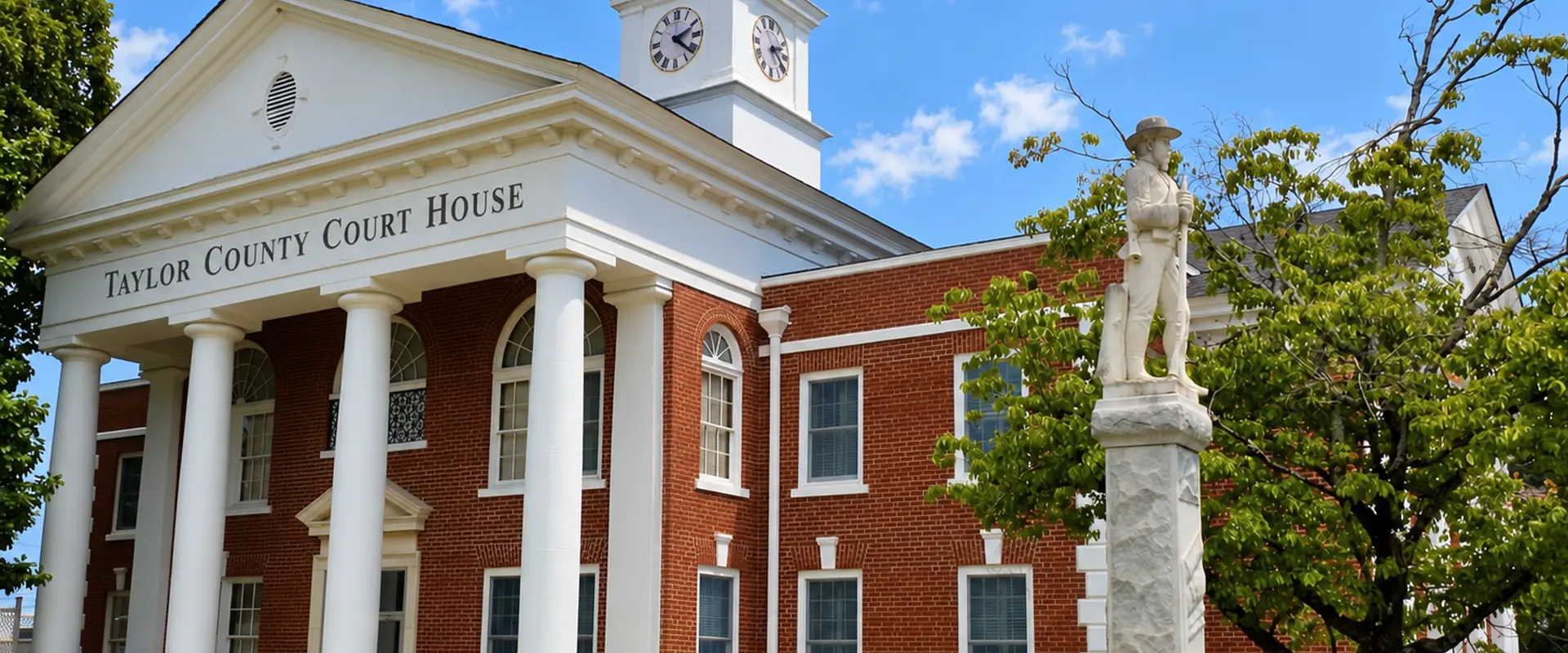
Taylor County Courthouse (Superior and Juvenile Courts, Magistrate Court, Probate Court)
Butler
Address: 2 North Broad Street, Butler, GA 31006
Superior and Juvenile Courts: (478) 862-5594
Probate Court & Magistrate Court: (478) 862-3357
Butler City Hall (Municipal Court of Butler)
Butler
Address: 12 Cedar Street, Butler, GA 31006
Phone: (478) 862-5435
Website: Municipal Court of Butler
The Armory (Municipal Court of Reynolds)
Reynolds
Address: 3 E William Wainwright Street, Reynolds, GA 31076
Phone: (478) 847-3435
Website: Reynolds Municipal Court
Legal and Self-Help Resources
Marginalized communities of Taylor County struggling to find justice can receive assistance from Middle Georgia Justice. The organization provides free legal aid, referrals to free legal representation, and community education, especially for civil matters. Georgia Legal Aid also helps disadvantaged residents access court forms and legal information they need when representing themselves in court. They also assist with referrals to other legal aid agencies. Self-represented parties who don't know where to start when filing their cases or defending themselves can also ask for help from the various court clerks who can assist with accessing required court forms and guide them on what is expected of them.
FAQs
Does Taylor County have a State Court?
Compared to other counties in Georgia, Taylor County doesn't have a State Court. Instead, all matters that the court would otherwise handle are heard by the Superior Court, which also administers the duties of the Juvenile Court. There are also the Magistrate, Probate, and Municipal courts to handle the other cases.
What do I do if I cannot find court records online?
If court records are not available online, chances are that they are not digitized or are older archived records. These can be accessed in person from the relevant clerks' offices that maintain older records or from the state archives, which is a database of historical and genealogical records from the state.
When is it helpful to use a third-party records finder?
CourtCaseFinder is a third-party records search tool that is a convenient alternative to state-provided systems. It compiles accurate records from various sources into a single platform that makes online searches simpler and faster. There is no need for inquirers to search through multiple sites or check with different offices.
Can I find Juvenile Court records online in Taylor County?
Due to the sensitive nature of Juvenile records, the findings are often sealed by the courts for the privacy of the minors involved. The records are not easily accessible online or in person. Only authorized parties like the minors, their parents, their attorneys, and other legal professionals on the case can access them.
Other Counties in Georgia
- Appling
- Atkinson
- Bacon
- Baker
- Baldwin
- Banks
- Barrow
- Bartow
- Ben Hill
- Berrien
- Bibb
- Bleckley
- Brantley
- Brooks
- Bryan
- Bulloch
- Burke
- Butts
- Calhoun
- Camden
- Candler
- Carroll
- Catoosa
- Charlton
- Chatham
- Chattahoochee
- Chattooga
- Cherokee
- Clarke
- Clay
- Clayton
- Clinch
- Cobb
- Coffee
- Colquitt
- Columbia
- Cook
- Coweta
- Crawford
- Crisp
- Dade
- Dawson
- Decatur
- Dekalb
- Dodge
- Dooly
- Dougherty
- Douglas
- Early
- Echols
- Effingham
- Elbert
- Emanuel
- Evans
- Fannin
- Fayette
- Floyd
- Forsyth
- Franklin
- Fulton
- Gilmer
- Glascock
- Glynn
- Gordon
- Grady
- Greene
- Gwinnett
- Habersham
- Hall
- Hancock
- Haralson
- Harris
- Hart
- Heard
- Henry
- Houston
- Irwin
- Jackson
- Jasper
- Jeff Davis
- Jefferson
- Jenkins
- Johnson
- Jones
- Lamar
- Lanier
- Laurens
- Lee
- Liberty
- Lincoln
- Long
- Lowndes
- Lumpkin
- Macon
- Madison
- Marion
- Mcduffie
- Mcintosh
- Meriwether
- Miller
- Mitchell
- Monroe
- Montgomery
- Morgan
- Murray
- Muscogee
- Newton
- Oconee
- Oglethorpe
- Paulding
- Peach
- Pickens
- Pierce
- Pike
- Polk
- Pulaski
- Putnam
- Quitman
- Rabun
- Randolph
- Richmond
- Rockdale
- Schley
- Screven
- Seminole
- Spalding
- Stephens
- Stewart
- Sumter
- Talbot
- Taliaferro
- Tattnall
- Telfair
- Terrell
- Thomas
- Tift
- Toombs
- Towns
- Treutlen
- Troup
- Turner
- Twiggs
- Union
- Upson
- Walker
- Walton
- Ware
- Warren
- Washington
- Wayne
- Webster
- Wheeler
- White
- Whitfield
- Wilcox
- Wilkes
- Wilkinson
- Worth
Table of Contents
