Table of Contents
Franklin County Courts, GA *

Franklin County courts play a significant role in the county, as they help manage legal matters affecting residents and visitors alike. Some of the cases they handle include civil claims, criminal felonies and misdemeanors, probate and land cases, county ordinance violations, juvenile cases, and traffic offenses. Residents with ongoing or closed cases use court records to help them prepare for a court hearing, review court orders, and check case details. Understanding how Franklin County's court system works and where to access the required court records is important, as it helps avoid delays and frustrations with case processing and research.
How to Access Franklin County Court Records

 Online Access
For online access to court records in Franklin County, the main sources are the Georgia Superior Court Clerks Cooperative Authority (GSCCA) Record Search and the KoFile Quicklinks portal, which is operated by the Clerk of Superior Court. One should gather as much information as possible about the case before starting the search to speed up the process. This info includes the case number, the names of the parties involved in the case, and filing dates, to access case documents through the official systems.
 Alternative Online Options
Official online systems may be frustrating and confusing to navigate, and that's where alternative online platforms come in. CourtCaseFinder provides access to publicly available court records from various sources, combined into a single platform. Those who require records from multiple jurisdictions, such as across the county or state, can also use this site for easy access.
 In-Person Requests
Another way to access court records is via an in-person request. Individuals can submit their record requests in person at the office of the Franklin County Clerk of Courts, especially for records that do not appear in online searches, are older, or have not yet been uploaded to the system. The clerk's office staff will help with finding:
- Court records in archives
- Physical case files
- Certified copies of court documents
When visiting the clerk's office, one should bring along court record identifiers, including case numbers, filing dates, and names of the involved parties.
 Archived Records
Older court records are often not digitized and are stored in archives. Most of these records are available at the archives maintained by the Franklin County Clerk of Superior Court. But the public can use the KoFile Quicklinks records search portal to access older land and property records from early 1948 to 1989. The Georgia Archives also stores historical court records that may be useful for legal and genealogical research, as well as for preparing for a court hearing.
Overview of the Franklin County Court System

Franklin County's court system is part of the Georgia judicial system under the supervision of the Georgia Judicial Council. The Georgia judicial system comprises two courts of appeals and several trial courts, including Superior, State, Magistrate, Probate, and Juvenile Courts. The Supreme Court of Georgia is the highest court of appeals. At the same time, the Court of Appeals of Georgia acts as the intermediate appellate court that reviews cases from the trial courts before they reach the Supreme Court. Franklin County, among others, falls under the Northern Judicial Circuit.
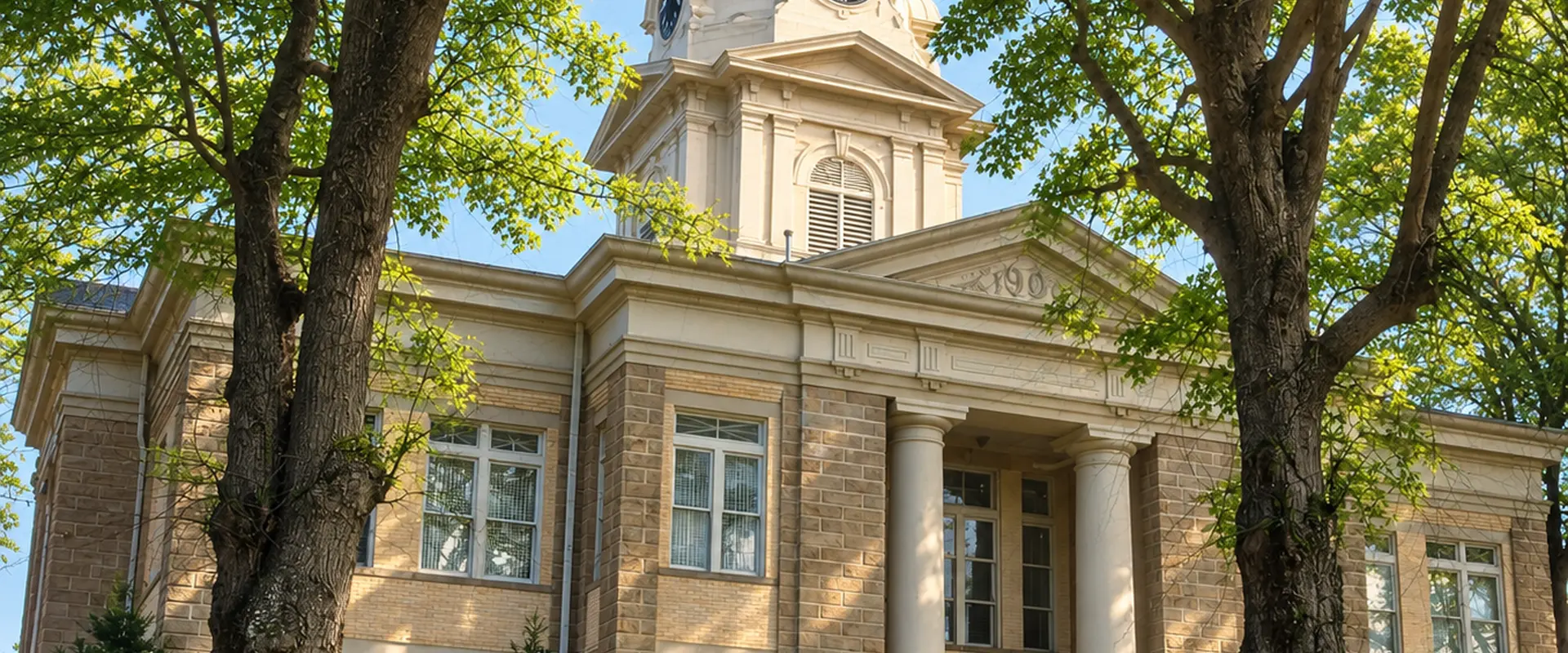
Franklin County trial courts not only adhere to the Georgia court rules but also follow local rules to ensure balance and uniformity. The Franklin County Courthouse in Carnesville is where most legal activities in the county take place, as it houses the clerk of courts' office. It is also where the Superior and Juvenile Courts are found. However, the county's Probate and Magistrate Courts are located in the Franklin Justice Center. There are also municipal courts in the cities of Canon, Franklin Springs, Lavonia, and Royston in the county, which handle city ordinance violations and traffic offenses within their respective city boundaries.
Types of Courts in Franklin County, Georgia
 Superior Court
The Superior Court is responsible for serious criminal and civil lawsuits. The Franklin County Superior Court is part of the Northern Judicial Circuit and is a trial court of general jurisdiction.
Primary location: Franklin County Superior Courthouse, Carnesville
This court's jurisdiction covers:
- Felony cases
- Divorce
- Civil claims exceeding $15,000
- Injunctions and equity
- Child custody and support matters
- Land title disputes
- Appeals from the lower courts
 Juvenile Court
The Juvenile Court is also located in the Franklin County Superior Courthouse. This court only handles legal issues involving minors. It focuses on child protection and rehabilitation.
Its jurisdiction consists of cases such as:
- Unruly behavior cases
- Juvenile delinquency matters
- Child protection and dependency cases
- Traffic offenses committed by minors
 Probate Court
The Probate Court of Franklin County handles probate cases and traffic offenses occurring in the county. This court handles complex cases that may require the services of attorneys.
Primary location: Franklin County Justice Center, Carnesville
Cases under its jurisdiction include:
- Administration of estates
- Guardianships
- Probation of wills
- Misdemeanors
- Traffic offenses
 Magistrate Court
The Franklin County Magistrate Court is usually a person's first experience with the county's legal system. This court provides a simple and quick way to handle minor civil claims and preliminary legal issues.
Primary location: Franklin County Justice Center, Carnsville
This court's jurisdictional areas cover cases like:
- Violation of county ordinances
- Small claims
- Civil claims not more than $15,000
- Dispossessory actions
- Garnishments
- Limited misdemeanors
 Municipal Courts
Municipal courts were created to manage traffic cases and municipal ordinance violations occurring within the limits of the cities in which they are situated. Franklin County's active municipal courts include the Canon, Franklin Springs, Lavonia, and Royston Municipal Courts.
Their jurisdiction is similar and includes cases such as:
- Violations of city ordinances
- Traffic offenses
- Misdemeanors
How to File a Case in Franklin County

To file a case with the correct court and submit the required documents, individuals should pay close attention to details. There is a filing procedure that filers should follow to avoid errors that could lead to a case dismissal, delay, and additional charges.
 Step 1: Choose the Correct Court
The first step is to determine the correct court with jurisdiction over the type of case to be filed. Franklin County courts have distinct jurisdictions; for instance, the Superior Court handles most serious criminal and civil cases, equity cases, and land title disputes, whereas the Magistrate Court is tasked with managing a wide range of legal issues in the county, including minor claims, foreclosure of personal property, county ordinance violations, bad checks, and dispossessory actions, such as landlord-tenant cases. Individuals with Probate proceedings, such as guardianships, probate of wills, and traffic cases, should file with the Probate Court; for cases involving minors, the Juvenile Court is the correct court.
 Step 2: Complete Required Forms
Filers must collect the necessary forms and then complete them thoroughly. Statewide Standard Filing Forms are available for most cases, including civil, criminal, and domestic-related cases. Meanwhile, the Franklin County Probate Court's forms are accessible on its own website. The forms must be completed accurately, with all sections filled out and with all the required information being provided. Supporting documents for certain cases must be attached to the filing if they are required by the court.
 Step 3: File the Case
The next step of case filing is to submit the documents to the office of the clerk of the courts in the county's courthouse. E-filing for civil cases in Franklin County is mandatory if they are handled by attorneys. Online filing is through the clerk of courts' website. Self-filers can also file online in addition to in person at the court. The clerk will check the documents and assign a case number.
 Step 4: Pay Filing Fees
To successfully file a case in Franklin County, there are fees to be paid when submitting the filing documents. Filing fees are determined by the court and the type of case being filed. It is better to contact the clerk's office to confirm the current fee schedule. An application for a fee waiver is allowed for those unable to afford the filing fees. The application is made by filing the Paupers' Affidavit form along with any proof of financial challenges with the court.
 Step 5: Serve the Other Party
The other party in the case must be properly served after the case has been successfully filed. The official notification can only be served by the sheriff's office, by certified mail, or by a private process server authorized by law. The filer is not allowed to serve their opponent themselves. A proof of service must be filed with the court after service is complete.
 Step 6: Monitor the Case
After successfully filing, both parties in the case should track it to ensure that they don't miss any important updates. They can use the case number to access the record through the GSCCA Record Search portal, or they can reach out to the clerk of courts for assistance. They can check for information such as hearing dates, court orders, or new motions.
Franklin County Courthouse Directory
Franklin County Superior Courthouse (Superior and Juvenile Courts)
Carnesville
Address: 9592 Lavonia Road, Carnesville, GA 30521
Phone: (706) 384-2514
Website: Franklin County Clerk of Superior and Juvenile Courts
Franklin County Justice Center (Probate and Magistrate Courts)
Carnesville
Address: 7085 Hwy 145, Carnesville, GA 30521
Phone:
Probate Court: (706) 384-2403
Magistrate Court: (706) 384-7473
Municipal Courts
Canon
Address: 5071 Hwy 17, Canon, GA 30520
Phone: (706) 245-8155
Franklin Springs
Address: 2531 W Main St., Franklin Springs, GA 30639
Phone: (706) 245-6957
Lavonia
Address: 12221 Augusta Rd., Lavonia, GA 30553
Phone: (706) 356-4848
Royston
Address: 830 Church St, Royston, GA 30662
Phone: (706) 245-6195
Legal and Self-Help Resources
Anyone with legal issues in Franklin County has access to all kinds of legal and self-help services and resources through organizations serving the area. These organizations include:
- The Georgia Legal Services Program offers free legal services and resources to people with civil cases, such as: housing, family law, consumer protection, and public benefits.
- Georgia Legal Aid provides free, easy-to-understand legal information to anyone facing a legal issue and needing help.
- The State Bar of Georgia Lawyer Referral Service helps individuals with complex cases requiring representation to find an attorney.
- Franklin County Elder Law Legal Aid & Pro Bono Services provides free or low-cost legal help with elder law issues for eligible residents and their families.
- Franklin County Family Legal Aid & Pro Bono Services provides low-cost or free legal assistance to residents facing family law matters.
- The Georgia Department of Veterans Services helps veterans, service members, and their families find legal services and resources to assist them with issues such as benefit claims.
FAQs
Are court records public in Franklin County?
Georgia's Open Records Act grants the right to access most of the county's court records. Most of these records can be obtained at the Clerk of Superior Court's office in the main courthouse or accessed on the GSCCA Record Search portal. However, it is important to note that some court records are sealed or have restricted access by court orders to protect privacy. Such records comprise juvenile cases, adoptions, and mental health cases, as well as certain information like Social Security numbers being censored.
Where can I find eviction records?
Eviction records in Franklin County are accessible at either the court at the Franklin Justice Center or through the Magistrate Court's website. To speed up the search, one can provide as much information as possible, including the case number, the names of the parties involved, or the property's address.
When is it helpful to use a third-party records finder?
There are various circumstances in which searchers may need to use third-party record finders to access the court records they need, for example, when they are overwhelmed by official databases or when they are searching across multiple jurisdictions. CourtCaseFinder can be helpful in such situations because it provides access to various records collected from multiple public sources.
Other Counties in Georgia
- Appling
- Atkinson
- Bacon
- Baker
- Baldwin
- Banks
- Barrow
- Bartow
- Ben Hill
- Berrien
- Bibb
- Bleckley
- Brantley
- Brooks
- Bryan
- Bulloch
- Burke
- Butts
- Calhoun
- Camden
- Candler
- Carroll
- Catoosa
- Charlton
- Chatham
- Chattahoochee
- Chattooga
- Cherokee
- Clarke
- Clay
- Clayton
- Clinch
- Cobb
- Coffee
- Colquitt
- Columbia
- Cook
- Coweta
- Crawford
- Crisp
- Dade
- Dawson
- Decatur
- Dekalb
- Dodge
- Dooly
- Dougherty
- Douglas
- Early
- Echols
- Effingham
- Elbert
- Emanuel
- Evans
- Fannin
- Fayette
- Floyd
- Forsyth
- Fulton
- Gilmer
- Glascock
- Glynn
- Gordon
- Grady
- Greene
- Gwinnett
- Habersham
- Hall
- Hancock
- Haralson
- Harris
- Hart
- Heard
- Henry
- Houston
- Irwin
- Jackson
- Jasper
- Jeff Davis
- Jefferson
- Jenkins
- Johnson
- Jones
- Lamar
- Lanier
- Laurens
- Lee
- Liberty
- Lincoln
- Long
- Lowndes
- Lumpkin
- Macon
- Madison
- Marion
- Mcduffie
- Mcintosh
- Meriwether
- Miller
- Mitchell
- Monroe
- Montgomery
- Morgan
- Murray
- Muscogee
- Newton
- Oconee
- Oglethorpe
- Paulding
- Peach
- Pickens
- Pierce
- Pike
- Polk
- Pulaski
- Putnam
- Quitman
- Rabun
- Randolph
- Richmond
- Rockdale
- Schley
- Screven
- Seminole
- Spalding
- Stephens
- Stewart
- Sumter
- Talbot
- Taliaferro
- Tattnall
- Taylor
- Telfair
- Terrell
- Thomas
- Tift
- Toombs
- Towns
- Treutlen
- Troup
- Turner
- Twiggs
- Union
- Upson
- Walker
- Walton
- Ware
- Warren
- Washington
- Wayne
- Webster
- Wheeler
- White
- Whitfield
- Wilcox
- Wilkes
- Wilkinson
- Worth
Table of Contents
